
- Your cart is empty
- Continue shopping
-
KN
- Posted on
- Categories:Blog
- 0 comments
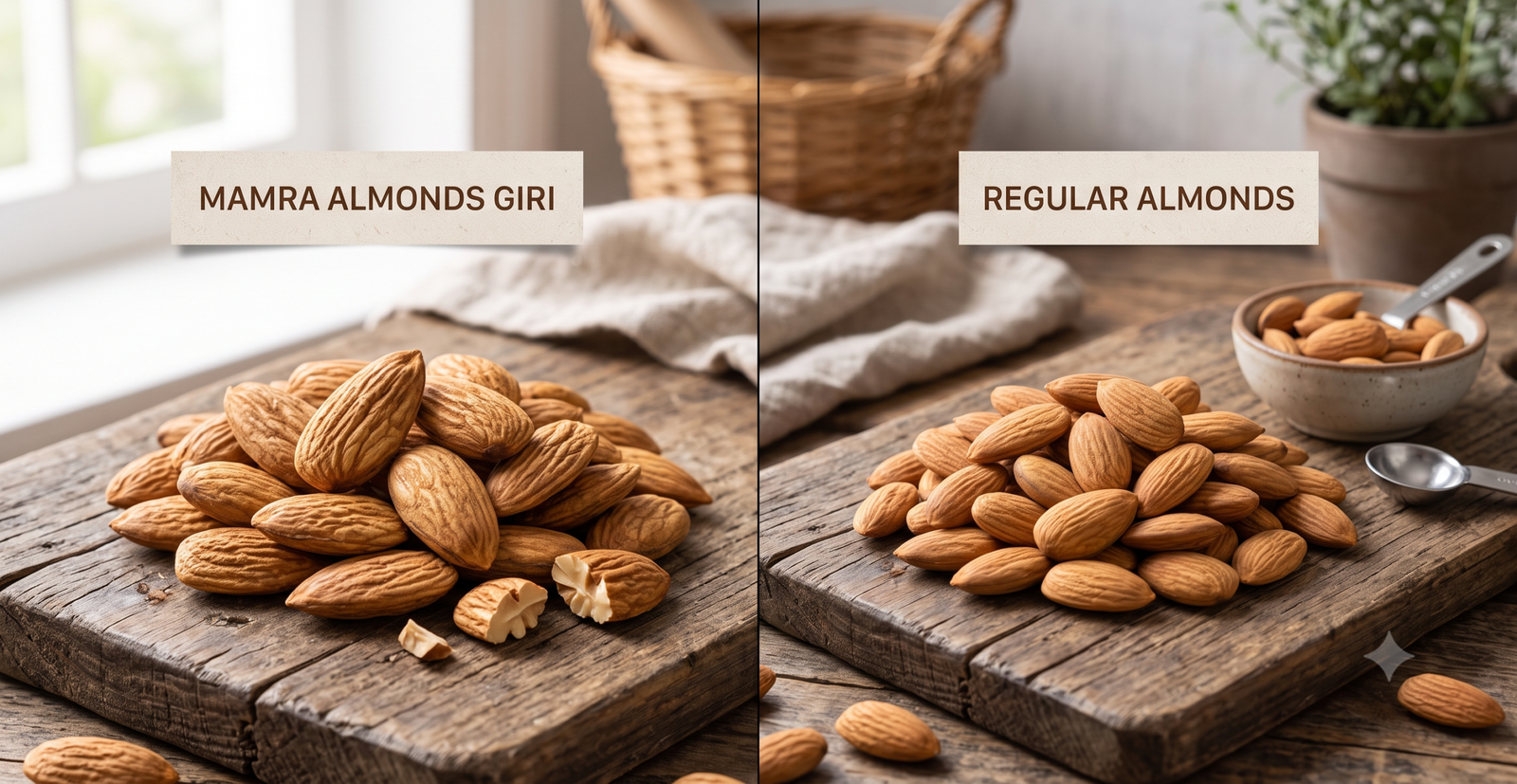
If you’ve shopped for almonds online recently, you’ve probably noticed something confusing: regular almonds cost around ₹600–₹900 per kg, while Mamra almonds can cost ₹2,500–₹4,000 per kg or more. That’s a 3-4x price difference for what looks like the same nut.
So what actually makes Mamra almonds so much more expensive-and is the higher price genuinely justified, or is it just clever marketing? Here’s a clear, honest breakdown.
What Are Mamra Almonds?
Mamra almonds are a wild, non-hybrid variety of almond that grows naturally in select regions of Afghanistan, Iran, and parts of Kashmir, without the irrigation and mass-farming methods used for regular (Californian or Gurbandi) almonds. They grow slower, produce a much smaller yield per tree, and are harvested largely by hand.
Regular almonds-the kind found in most supermarkets-are typically Californian almonds, grown on large irrigated farms with high-yield hybrid trees, which is what keeps their price low and supply consistent.
The Real Reasons Mamra Almonds Cost More
1. Extremely limited supply Mamra almond trees produce far fewer almonds per harvest compared to hybrid Californian trees. Low supply combined with steady demand naturally pushes the price up.
2. Harder to shell: Mamra almonds have an unusually hard, wrinkled shell that must often be cracked by hand rather than machine, which adds significant labor cost.
3. Slower natural growth Without heavy irrigation or fast-growing hybrid cultivation, Mamra trees take longer to mature and yield less per season—driving up the cost per kilogram.
4. Higher oil and nutrient content Mamra almonds contain noticeably more natural oil than regular almonds, which is part of why they taste richer and are traditionally considered more nutrient-dense.
Mamra Almonds vs. Regular Almonds: Nutrition Comparison
| Factor | Mamra Almonds | Regular Almonds |
|---|---|---|
| Natural oil content | Higher | Lower |
| Taste | Rich, buttery, slightly sweet | Milder, more neutral |
| Texture | Denser, slightly wrinkled | Smoother, uniform |
| Shell | Hard, irregular | Softer, easy to crack |
| Price per kg | ₹2,500–₹4,000+ | ₹600–₹900 |
| Availability | Limited, seasonal | Widely available year-round |
Both types offer protein, fiber, vitamin E, and healthy fats-the core nutritional benefits of almonds. The difference isn’t that regular almonds are “unhealthy”; it’s that Mamra almonds are more nutrient-dense per gram due to their higher natural oil content, and many people find their flavor noticeably richer.
Is the Price Difference Actually Worth It?
Here’s the honest answer: it depends on why you’re buying almonds.
Mamra almonds are worth it if:
- You want maximum nutrient density in smaller quantities (a little goes a long way)
- You’re buying for a specific health protocol (e.g., soaked almonds daily, traditional Ayurvedic use)
- You want the richest possible taste for gifting or special occasions
- You value authenticity and traditional sourcing over mass production
Regular almonds make more sense if:
- You’re using large quantities regularly (baking, daily snacking in bulk)
- Budget is the primary concern
- You’re using almonds as an ingredient rather than eating them on their own
A practical approach many of our customers take: use Mamra almonds for daily soaked-almond routines or gifting, and regular almonds for everyday cooking and baking where the price difference adds up quickly.
How to Tell Real Mamra Almonds From Fake Ones
Because of the price gap, mislabeling is common. Genuine Mamra almonds are:
- Smaller and more wrinkled than regular almonds, not larger
- Denser and heavier for their size
- Slightly sweet and buttery when eaten raw, not bland
- Sold with visible shell irregularity if bought unshelled
If a seller offers “Mamra almonds” at close to regular almond prices, it’s very likely mislabeled Gurbandi or Californian almonds.
Frequently Asked Questions
Are Mamra almonds healthier than regular almonds?
Mamra almonds have a higher natural oil and nutrient concentration, making them more nutrient-dense per gram, though both types provide similar core nutrients like protein, fiber, and vitamin E.
Why are Mamra almonds so expensive?
Mamra almonds are expensive mainly due to low yield per tree, hand-shelling labor, and limited regional availability compared to mass-farmed regular almonds.
Can I substitute regular almonds for Mamra almonds in recipes?
Yes, for cooking and baking, regular almonds work fine. Mamra almonds are best appreciated when eaten on their own, soaked, or in traditional preparations where their distinct flavor stands out.
How should I store Mamra almonds to keep them fresh?
Store them in an airtight container in a cool, dry place, away from direct sunlight-due to their higher oil content, they can turn rancid faster than regular almonds if left exposed to heat or moisture.
